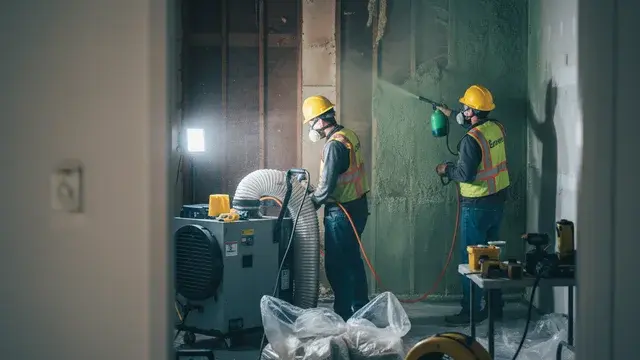
Restoration professionals talk constantly about response time — how important it is, how critical the first hour or first day is. But what actually changes hour by hour when water damage, fire damage, or mold is left untreated? Here is the real timeline of consequences.
The First Hour — Extraction Window
In the first hour after water damage, most of the water is still on the surface. Standing water is relatively easy to extract. Porous materials are just starting to absorb water.
Professional extraction in the first hour removes a huge percentage of the water before it soaks deeper — which is why emergency response time is the single biggest factor in how much gets saved.
Hours 2 to 6 — Spreading Damage
Within a few hours, water has wicked into wall cavities, under flooring, and through subfloors. Drywall begins to swell. Carpet pad has become saturated.
Extraction is still effective but now requires more work. Materials that could have been dried are becoming candidates for removal.
Hours 6 to 24 — Biology Starts
By the 24-hour mark, bacteria are multiplying on wet materials. Porous surfaces are fully saturated. Hardwood floors are beginning to cup.
Mold spores are not yet visible but are activating in the right conditions. The window for preventing mold is still open but narrowing.
Days 1 to 3 — The Mold Window
Between 24 and 72 hours after water damage, mold colonies begin forming. What starts as invisible spore activation becomes measurable growth.
Materials that were borderline salvageable often become non-salvageable during this window. Insurance claim amounts increase substantially.
Days 3 to 7 — Compounded Damage
After 72 hours, mold growth is often visible. Wood framing may show staining and warping. Drywall has lost structural integrity.
What could have been a mitigation-only event at 6 hours has become a remediation-required project at 96 hours.
The Cost Curve
The cost of restoration typically looks like this:
- Response within 6 hours — minimal structural demo, maximum materials saved
- Response within 24 hours — standard restoration scope
- Response after 48 hours — extended demo, antimicrobial treatment required
- Response after 72 hours — mold remediation often required, major material replacement
- Response after 1 week — near-total rebuild of affected areas
Why Local Matters for Response Time
Local restoration companies like Good Fellas Restoration, based in Red Oak at 301 Collin St, have structural advantages over national chains with distant dispatch:
- Shorter driving distance to your property
- Local inventory of equipment
- Familiarity with local conditions and common causes
- Relationships with local plumbers, electricians, and trades
- Local insurance adjuster relationships
What to Do Right Now
If you have water damage, fire damage, or any major loss in progress:
- Do not wait for morning if it is night
- Do not wait until Monday if it is Saturday
- Do not wait for the insurance company to call back
- Call a 24/7 restoration team immediately
- Document the damage while you wait
- Protect what you can safely
Final Thoughts
Restoration response time translates directly into damage, cost, and time out of your property. Good Fellas Restoration responds 24/7 from our Red Oak location because fast response is the single biggest lever in the restoration process.