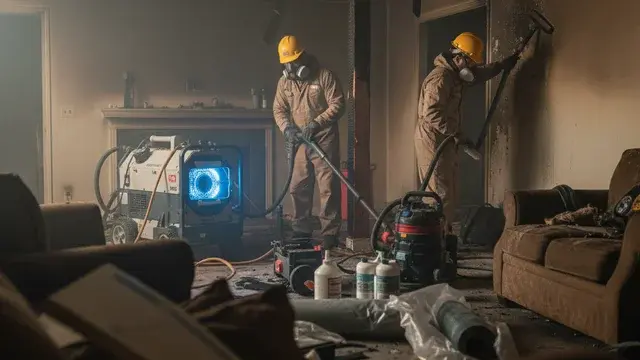
A fire in your home or business creates three distinct damage types that all need to be addressed together — the fire damage itself, smoke damage that often extends far beyond the flames, and water damage from the firefighting effort. Here is how to handle all three so you can start recovery properly.
Immediate Safety First
Before anything else, do not re-enter the building until the fire department has cleared it as safe. Fire can leave structural damage that is not visible, hot spots that can reignite, and air quality conditions that are not immediately obvious.
Even after clearance, use extreme caution. Wear closed-toe shoes, long sleeves, and a dust mask at minimum when first re-entering.
The Triple Damage Types
Every fire creates damage in three categories that have to be addressed together:
- Fire damage — burned materials, structural damage, and charring
- Smoke damage — soot, odor, and smoke infiltration throughout the property
- Water damage — from firefighting efforts, often significant
Fire Damage — The Visible Destruction
Fire damage is usually the most visible and obvious. Burned materials, charred framing, melted fixtures, and destroyed contents need to be documented, removed, and rebuilt.
The extent of fire damage is rarely the largest problem in the overall restoration. Smoke and water damage usually affect far more square footage.
Smoke Damage — The Hidden Spread
Smoke travels. It goes into every wall cavity, every vent, every closet, every drawer. A small kitchen fire can leave smoke damage throughout an entire home.
Smoke damage includes:
- Soot residue on walls, ceilings, and contents
- Odor that embeds in porous materials
- Discoloration of paint and finishes
- Corrosion of metals from acidic soot
- Contamination of HVAC systems
Water Damage — The Overlooked Disaster
Firefighting typically uses thousands of gallons of water. Fire hoses deliver water at 100 to 250 gallons per minute. By the time the fire is out, most of the building below the fire area is soaked.
Water damage from firefighting becomes its own emergency. It needs extraction, drying, and mold prevention just like any other water loss. If it is not addressed in the first 24 to 48 hours, you add a mold problem on top of the fire problem.
The Proper Response Order
Professional fire restoration addresses all three damage types in the correct order:
- Step 1 — Emergency board-up and roof tarping to secure the property
- Step 2 — Water extraction and drying before mold can develop
- Step 3 — Soot and smoke residue cleaning before it becomes permanent
- Step 4 — Odor treatment after surfaces are clean
- Step 5 — Content pack-out and cleaning
- Step 6 — Demolition of non-salvageable materials
- Step 7 — Reconstruction to pre-loss condition
What Homeowners Should Do
Once the fire is out and the property is cleared:
- Call your insurance company to open a claim
- Call a professional fire restoration company
- Document everything with photos and video
- Make a list of contents, especially high-value items
- Secure important documents (birth certificates, deeds, insurance policies)
- Arrange temporary housing if the property is uninhabitable
What Not to Do
A few mistakes commonly make fire damage worse:
- Do not wipe soot off walls — it smears and causes permanent damage
- Do not turn on the HVAC system — it spreads soot and smoke
- Do not attempt to clean fabrics or carpet — professional methods are required
- Do not re-light gas appliances — have them inspected first
- Do not throw anything out before the adjuster sees it
Insurance for Fire Damage
Fire damage is a covered peril under every standard homeowners and commercial property policy. Coverage typically includes:
- Building repair and replacement
- Contents replacement (personal property)
- Additional living expenses for temporary housing
- Smoke and water damage caused by the fire
- Emergency board-up and tarping
Final Thoughts
Fires create layered damage that demands layered response. Good Fellas Restoration handles fire, smoke, and water damage together as a single-source restoration project across Red Oak, TX and surrounding cities.